Last Updated on: 6th June 2025, 07:14 am
Place de Clichy is one of my favorite spots in Paris. I’ve been passing by hundreds of times since 2014, yet failed to notice the shiny metal apple on a stone pedestal standing right in the middle of the square.
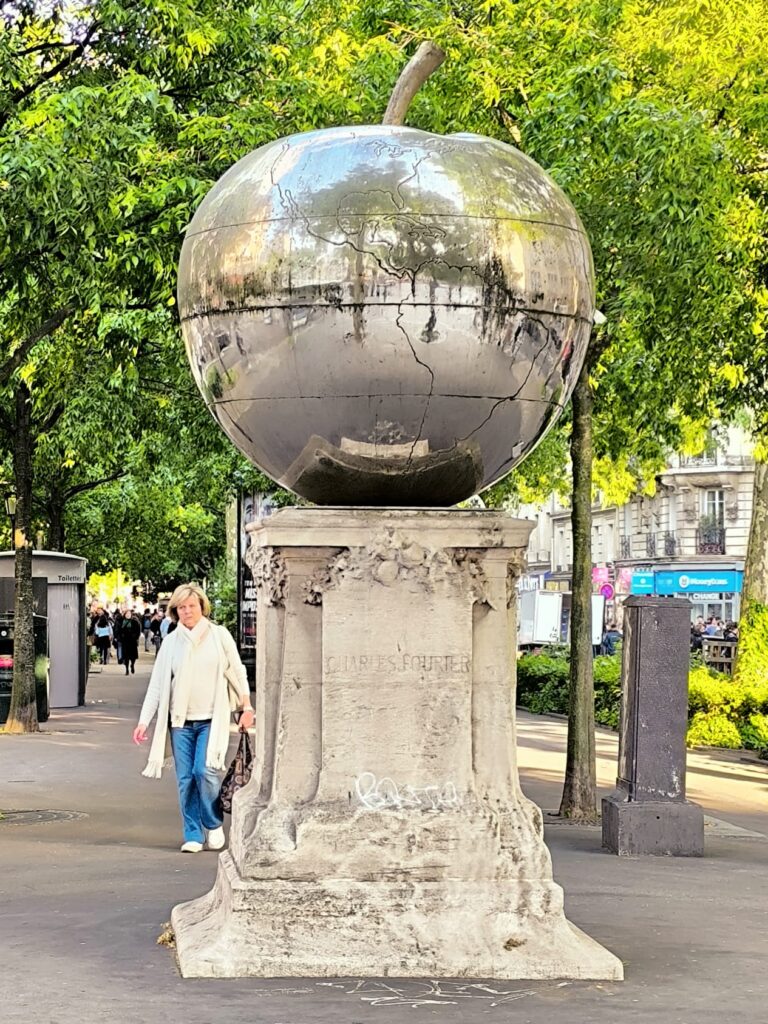
This year, as I was waiting for my friends to cross the street, I noticed the giant apple for the very first time. At a closer look, it’s easy to see that this sculpture literally holds the entire world. Here’s what I’ve found out about it.
La Quatrième Pomme, or The Fourth Apple, is far more than meets the eye.
This unusual steel sculpture, created by French artist Franck Scurti and inaugurated in 2011, features the world’s countries engraved into its reflective surface. As you walk around it, you can see how the world map changes, reflecting different different things around the monument.
But why an apple? And why the fourth one?
A Monument Born from Tragedy
Contents
The story of The Fourth Apple begins not in 2011, but in the dark days of World War II.
Originally, the pedestal featured a bronze statue of Charles Fourier, the French philosopher and social theorist who stood for utopian socialism and workers’ rights. For decades, Fourier’s statue watched over the square, a testament to progressive ideals and social reform. (source: https://en.wikipedia.org/wiki/Charles_Fourier)
Then came 1942, and the Nazi occupation of Paris changed everything. Like many other bronze monuments across Europe, Fourier’s statue was melted down by the German forces, in dire need for raw material for their weapons.
The Artist’s Vision
When Franck Scurti was commissioned to create a new monument for Place de Clichy, he faced a unique challenge: how do you replace a philosopher’s statue in a way that honors both the past and the present? His answer was brilliantly symbolic.
The apple has always been important in Western culture, from Adam and Eve’s Bible story to Newton’s discovery.
Scurti’s “fourth apple” refers to the three most famous apples: the one from the Garden of Eden, the one that fell on Newton’s head, and Apple’s company logo. His apple is the fourth and it represents our connected global world.
A World in Steel
What makes The Fourth Apple really interesting is its detailed surface. Every country, every border, every piece of land has been carefully carved into the steel, creating a 3D world map that wraps around the sculpture. As the sun moves across the sky, different continents catch the light, and as you walk around the monument, your view of the world changes.
This isn’t just art. It’s a powerful statement about how we see our planet. From one angle, you might see Europe taking up most of the view, while a few steps later, Africa becomes the focus. The sculpture makes viewers think about the fact that there is no single, “right” view of the world.
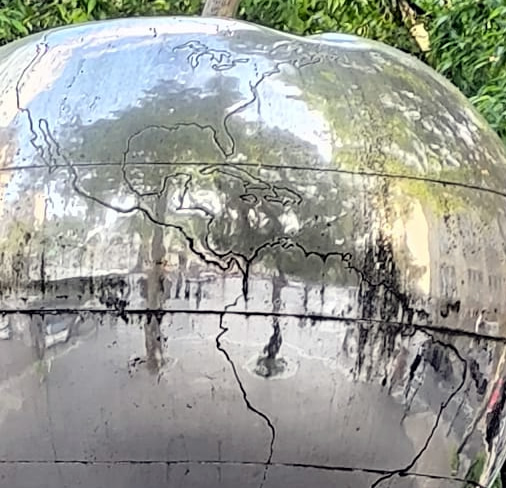
Is Paris the whole world?
The Reflection of Modern Paris
The Fourth Apple’s shiny surface also reflects the diversity of modern Paris itself. In its curved steel, you’ll see the faces of commuters from every continent, tourists from every nation, and the mix of cultures that defines today’s French society.
This reflection is especially important given the monument’s location in Place de Clichy, an area that has long been a crossroads of cultures and communities. The square sits where several arrondissements meet and serves as a gateway between central Paris and its diverse northern suburbs.
More Than Meets the Eye
I stood there for a while, observing the passers by. Most of them didn’t even notice the giant apple reflecting their distorted image.
Many think it’s just modern art without deeper meaning, or simply another example of contemporary sculpture placed in public spaces. But those who take the time to walk around it, to trace the continents with their eyes, to see their own reflection mixed with the world’s geography, discover something important.
The monument serves as a daily reminder that we are all connected, that the divisions we create between nations and peoples are, in many ways, artificial barriers. In an age of increasing nationalism and global division, Scurti’s Fourth Apple offers a different vision of a whole, unified, and shared world.
A Hidden Gem in Plain Sight
Perhaps what makes The Fourth Apple most interesting is how it hides in plain sight. Unlike the Eiffel Tower or the Louvre, this monument doesn’t appear on tourist maps or Instagram feeds. It doesn’t have crowds of visitors or souvenir shops nearby. Instead, it stands quietly in its square, waiting for those curious enough to stop and look.
I just can’t believe that I passed by it for so many years and never noticed it.
This quiet presence is part of its power. In a city filled with famous monuments and tourist attractions, The Fourth Apple reminds us that sometimes the most important art is the kind we stumble upon in our daily lives, the kind that makes us pause and think rather than simply snap a photo and move on.
Worth the Detour
Next time you find yourself in Paris, take a detour to Place de Clichy. Stand before The Fourth Apple and take a moment to truly see it. Walk around it slowly, watch how the continents shift and change, see your own reflection mingled with the world’s geography. In that moment, you’ll understand why this unassuming steel sculpture is one of Paris’s most profound monuments.
You’ll fine the Fourth Apple amazing. Take my word for it!