In the heart of Paris’s 14th arrondissement stands a church unlike any other.
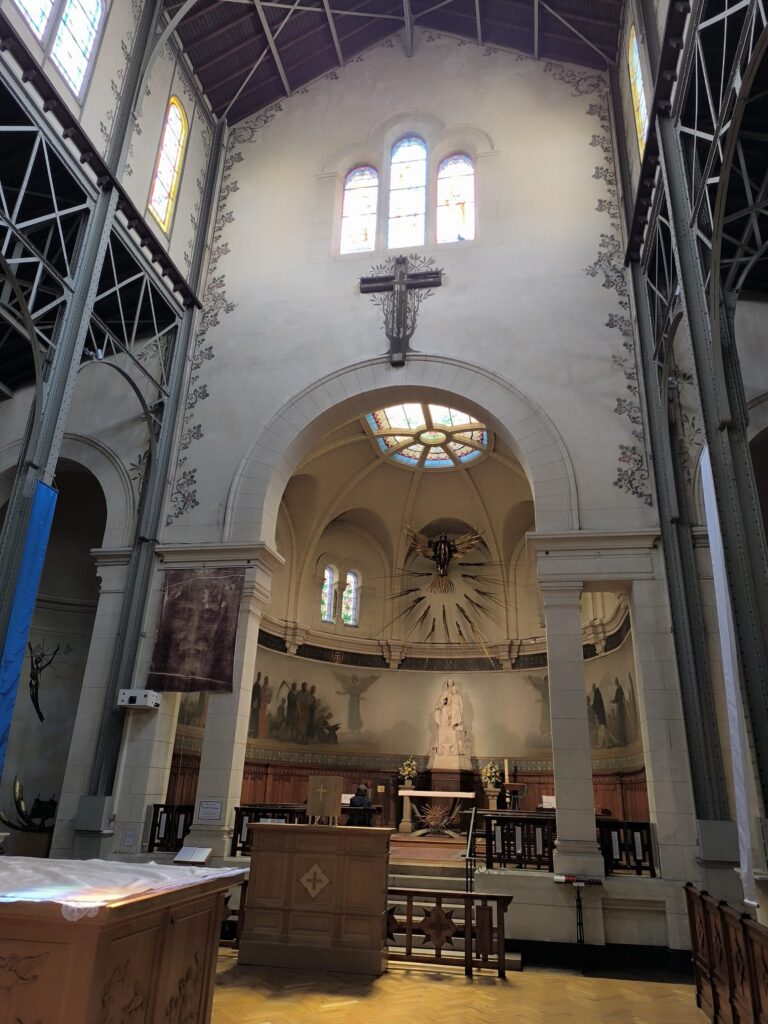
From the outside, Notre Dame du Travail appears as a conventional neo-Romanesque building with stone facades and octagonal towers. But step through its doors, and you’ll discover an extraordinary secret: a majestic cathedral that looks more like a factory than a place of worship, with 135 tons of exposed iron and steel rising toward the heavens.
As I stepped inside the church, I had the feeling that I entered my first workplace, a heavy machinery factory where I had spent four of my youth years.
A Church Built for Workers
Contents
The story of Notre Dame du Travail (Our Lady of Labor) begins in the late 19th century, when the Plaisance neighborhood was transforming from a small hamlet into an industrial hub. As the nearby Gare Montparnasse expanded, thousands of workers flooded into the area, many of them artisans and laborers who assembled the magnificent pavilions for Paris’s Universal Expositions.
By 1896, the neighborhood’s population had exploded to 35,000 residents, far exceeding the capacity of the small chapel on rue du Texel. Enter Father Roger Soulange-Bodin, a passionate advocate for social Catholicism who believed the church should serve the working class with dignity and respect. He launched a national fundraising campaign with a bold vision: to create a church where workers would feel at home, surrounded by the materials they transformed daily such as iron, steel, and wood.
Father Soulange-Bodin’s campaign asked: “Why a church? To unite workers of all classes on the ground of religion. Why in Paris? Because Paris is rightly considered the center of work and industry. Why in the Plaisance district? Because it’s a suburb composed entirely of workers who don’t yet have a church for their 35,000 inhabitants.” His goal was ambitious: the church must be ready for the 1900 Universal Exposition, so workers from around the world could pray in the sanctuary of the Virgin of Labor.
An Architectural Marvel
Architect Jules-Godefroy Astruc (1862-1955) brought Father Soulange-Bodin’s vision to life between 1897 and 1902. A student of Victor Laloux, who designed the metal-framed Gare d’Orsay, Astruc was well-versed in industrial architecture. Inspired by the Eiffel Tower, completed just a decade earlier, and the iron structures of Victor Baltard, he created something revolutionary: a church where the metal framework wasn’t hidden behind decorative plaster, but celebrated as the architecture itself.
The construction was as pragmatic as it was innovative. According to historical accounts, much of the steel framework was salvaged from the Palais de l’Industrie, built for the 1855 Universal Exhibition and demolished in 1899 to make way for the Grand and Petit Palais. These recycled materials were brought to a workshop on Boulevard de Vaugirard, where Astruc riveted them together according to his own plans, leaving every plate and rivet visible.
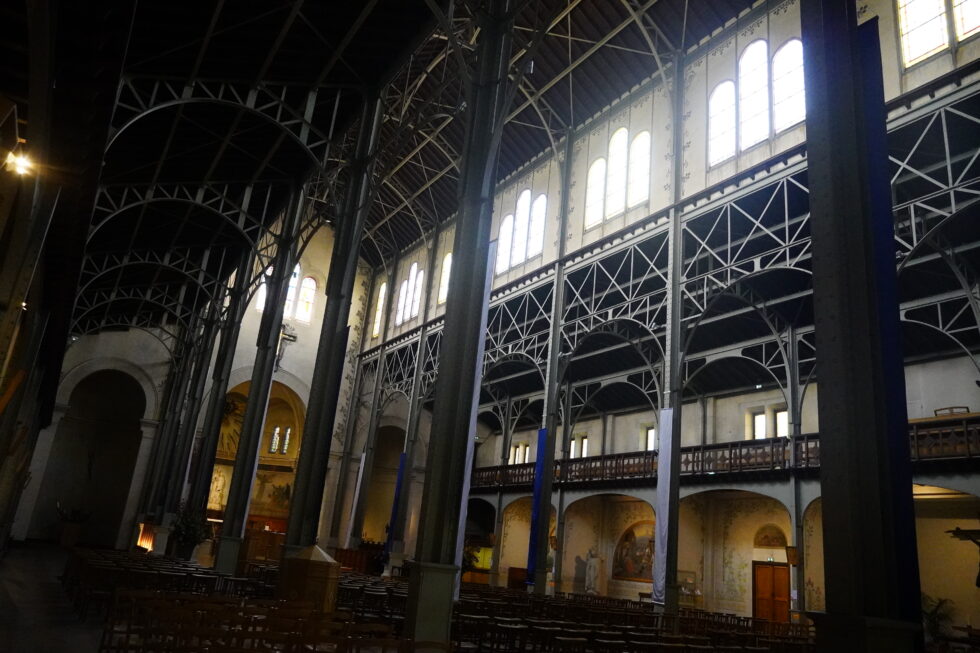
The church measures 59 meters long and 25 meters high, with a central nave flanked by two rows of steel columns. These industrial pillars replace the traditional stone columns of earlier churches, creating a space that deliberately evokes a factory floor. As Father Soulange-Bodin explained, the church was meant to “remind the worker of his factory so that he would feel at home, in his familiar environment, surrounded by the iron and wood materials that his hand transforms every day.”
Inside the Industrial Cathedral
Walking into Notre Dame du Travail is a breathtaking experience. The exposed steel framework soars overhead in graceful arcs, painted in pale green with the columns and chapels adorned in Art Nouveau style. Delicate floral designs in shades of green, pink, red, and lavender soften the industrial aesthetic, creating an unexpected harmony between the mechanical and the organic.
Two lateral galleries run the length of the nave on either side, reminiscent of churches in the Basque Country—a nod to Father Soulange-Bodin’s origins. High stained-glass windows, mostly clear to maximize natural light, illuminate the space with an ethereal glow. The goal, as the priest envisioned, was for “eyes to bathe in light and lungs to breathe pure air.”
The Chapel of the Virgin
Behind the main altar, in the neo-Romanesque apse, sits the Chapel of the Virgin—the spiritual heart of the church. Here stands a remarkable statue of Notre Dame du Travail, carved in 1898 by Joseph Lefèvre from a single block of limestone weighing seven tons. The Virgin Mary sits with the child Jesus, both depicted at working age. The statue’s base is decorated with carvings representing the tools of various trades: metallurgy, agriculture, goldsmithing, gardening—honoring all the professions of the parish workers.
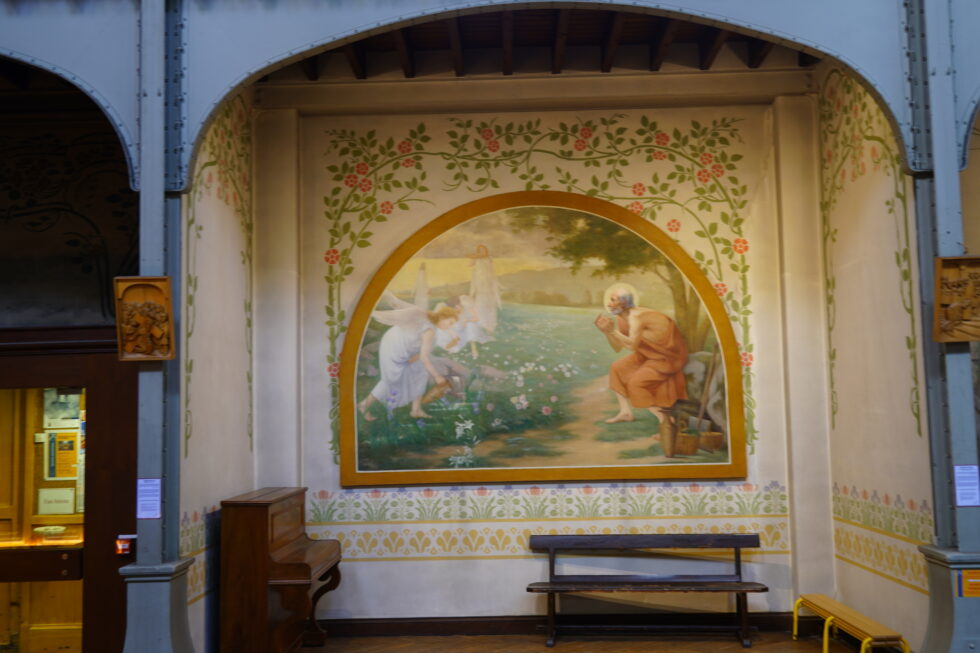
The chapel walls feature two monumental frescoes by Félix Villé, each measuring 2 meters high and 9 meters long. Created in 1904 and titled “Notre Dame du Travail, Assistance to the Afflicted,” these paintings form a hymn to work and charity. One depicts an angel appearing to workers of varied professions, while the other shows acts of charity including the liberation of captives, education of the young, and assistance to the sick.
Art and Symbolism Throughout
Throughout the church, art celebrates the dignity of labor. Side chapels honor patron saints of different trades: Saint Luke for art, Saint Francis of Assisi for poetic creation and ecology, Saint Éloi for metallurgy and goldsmithing, and Saint Fiacre for gardening. Each chapel features paintings and sculptures in the Art Nouveau style, with lavish floral designs adorning the walls.
A modern addition is the Stations of the Cross, installed in 1994. Created by sculptor Christine Audin, these 14 wooden bas-reliefs circle the interior without numbers—the order is revealed by the decreasing number of figures in each scene, creating a visual countdown to the Crucifixion.
A Bell from Crimea
Adding to the church’s unique history, the bell tower holds a massive 552-kilogram bell with an extraordinary provenance. After the Crimean War, French General Patrice de Mac-Mahon brought five bells from Sevastopol Cathedral as war trophies. Four went to Notre-Dame de Paris; Emperor Napoleon III donated the fifth to the Plaisance church in 1865. This bell was later transferred to Notre Dame du Travail, where it remained in the side garden until 1976, when a concrete portique was built atop the tower to properly display it.
Why Visit Notre Dame du Travail
- Architectural Innovation: This is the only workers’ church in Paris, and one of the first religious buildings in the world to showcase exposed metal framework as its primary aesthetic. It represents a revolutionary moment when industrial materials and methods entered sacred architecture.
- Hidden Gem Status: Unlike Paris’s famous landmarks, Notre Dame du Travail remains relatively undiscovered by tourists. You’re likely to experience its beauty in peaceful solitude, perhaps during a service where the community still gathers.
- Art Nouveau Treasures: The church showcases the Art Nouveau movement at its peak, with exquisite floral decorations that transform industrial girders into works of art.
- Social History: The church tells the story of Paris’s working-class neighborhoods, commemorating the laborers who built the city’s great monuments and exhibitions. It’s a rare monument to the dignity of manual labor.
- Photographic Opportunities: The contrast between the austere exterior and the spectacular interior creates dramatic visual interest. The play of light through the high windows on the pale green metalwork is particularly stunning.
- Free Concerts: The church regularly hosts free Sunday afternoon concerts. Check the church website for the current schedule.
- Living Community: Unlike many historic churches that feel like museums, Notre Dame du Travail remains an active parish with regular services, maintaining its original purpose of serving the local community.
How to Get There
Address: 59 rue Vercingétorix, 75014 Paris
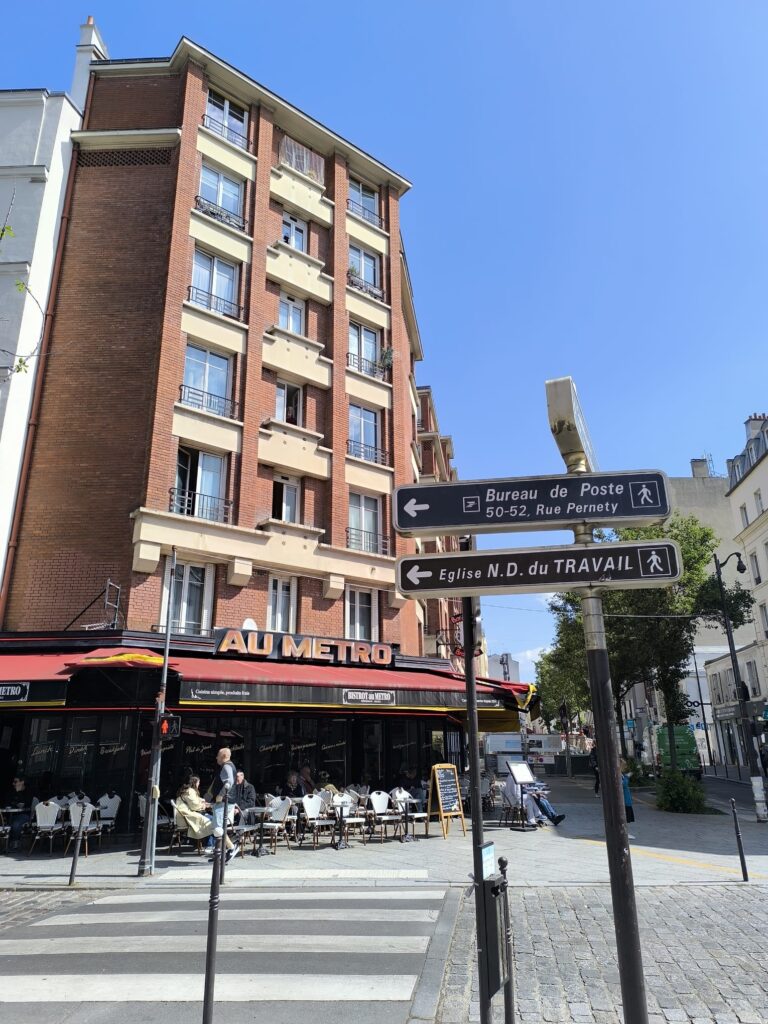
Metro: Pernety station (Line 13) – 3-minute walk Alternative stations: Plaisance or Gaîté (both also on Line 13)
Bus: Lines 28, 58, 88, 91
From Pernety Metro: Exit the station and turn left. Continue down the street to Square Cardinal-Wyszynski park. Turn right, and you’ll find the church’s main entrance on the pedestrian section of rue Vercingétorix.
Accessibility: A wheelchair-accessible entrance is available at 36 rue Guilleminot.
Hours: Monday-Friday: 7:30am-7:45pm; Saturday-Sunday: 9am-7:30pm (Check the official website for current hours: www.notredamedutravail.net)
Phone: +33 (0)1 44 10 72 92
Admission: Free
Visiting Tips
- The church is registered as a historic monument (classified July 5, 2016), ensuring its preservation for future generations.
- Guided tours in French are offered on the first Sunday of most months at 2:30pm, meeting beneath the grand organ.
- The contrast between exterior and interior is most striking when you know nothing about the building beforehand—try not to peek at photos before visiting!
- Visit during the European Heritage Days (Journées du Patrimoine) in September for special guided tours and extended hours.
- The neighborhood of Plaisance is worth exploring, with its mix of old Parisian charm and modern development, including the distinctive Place de Catalogne.
- Combine your visit with a stop at the nearby Montparnasse Cemetery or the Catacombs of Paris for a full day of exploring the 14th arrondissement.
Historical Postscript
Father Soulange-Bodin’s influence extended far beyond architecture. He established the first parish newspaper in the Diocese of Paris, campaigned against unsanitary housing and infant mortality, defended workers’ rights to unionize, and created employment programs for women. Under his leadership, Notre Dame du Travail became a training school for priests serving working-class neighborhoods and suburbs—the first community presbytery of its kind.
He left the parish in 1909 for Saint-Honoré-d’Eylau, where he served for 14 years until his death in May 1925. But his legacy endures in this extraordinary building, where the dignity of work is celebrated in iron and steel, and where beauty and humility meet beneath a canopy of rivets and girders.
Notre Dame du Travail stands as a testament to a moment when the Church recognized that sacred space could honor not just kings and nobility, but the calloused hands that built civilization itself. In a city filled with ornate cathedrals and gilded chapels, this industrial sanctuary remains a reminder that the divine can be found anywhere, even in the framework of a factory.
For the sake of the contrast, check out this article about Sacre Coeur Basilica in Montmartre.
Sources
- Wikipedia. “Notre-Dame-du-Travail, Paris.” https://en.wikipedia.org/wiki/Notre-Dame-du-Travail,_Paris
- Diocèse de Paris. “Notre-Dame du Travail.” https://dioceseparis.fr/-notre-dame-du-travail-.html
- Un jour de plus à Paris. “Notre-dame-du-travail Church.” https://www.unjourdeplusaparis.com/en/paris-culture/eglise-notre-dame-du-travail
- Atlas Obscura. “Notre Dame du Travail Church.” https://www.atlasobscura.com/places/notre-dame-du-travail-church
- Sortiraparis.com. “Notre-Dame-du-Travail church and its incredible metal structure.” https://www.sortiraparis.com/en/what-to-visit-in-paris/history-heritage/articles/172032-notre-dame-du-travail-church-and-its-incredible-metal-structure
- Paroisse Notre-Dame du Travail official website. “Histoire de l’église.” https://www.notredamedutravail.net/visites-et-concerts/histoire-de-l-eglise
- Vertiges de l’art. “Jules Astruc et l’église N.D du Travail (Paris 14).” https://vertigesdelart.net/2020/06/07/jules-astruc-et-leglise-n-d-du-travail-paris-14/