Last Updated on: 17th July 2025, 01:12 pm
Are you planning your first trip to Paris?
You may have already come across the name of Montmartre, as one of the must-see neighborhoods in the city.
While this is true, you need to know that, according to Wikipedia, Montmartre spreads across an area of about 60 ha (150 acres) around a hill.
On top of this hill, La Butte Montmartre, sits the Sacre Coeur church. This is one of the best places to enjoy Paris panorama views and to take photos of its skyline.
By the bottom of the hill there’s a less touristy area, with good restaurants where locals eat.
Many winding streets link the top and the bottom of this iconic hill. Rue Lepic, for instance, is notoriously romantic, as that’s where the Cafe des Deux Moulins is. If you’ve seen the movie Amelie, you must know what I mean.
Iconic Landmarks in Montmartre
Contents
Here’s a list for first-timers to Paris.
Sacré-Cœur Basilica
The white limestone basilica dominates the Montmartre skyline and offers panoramic views over Paris.
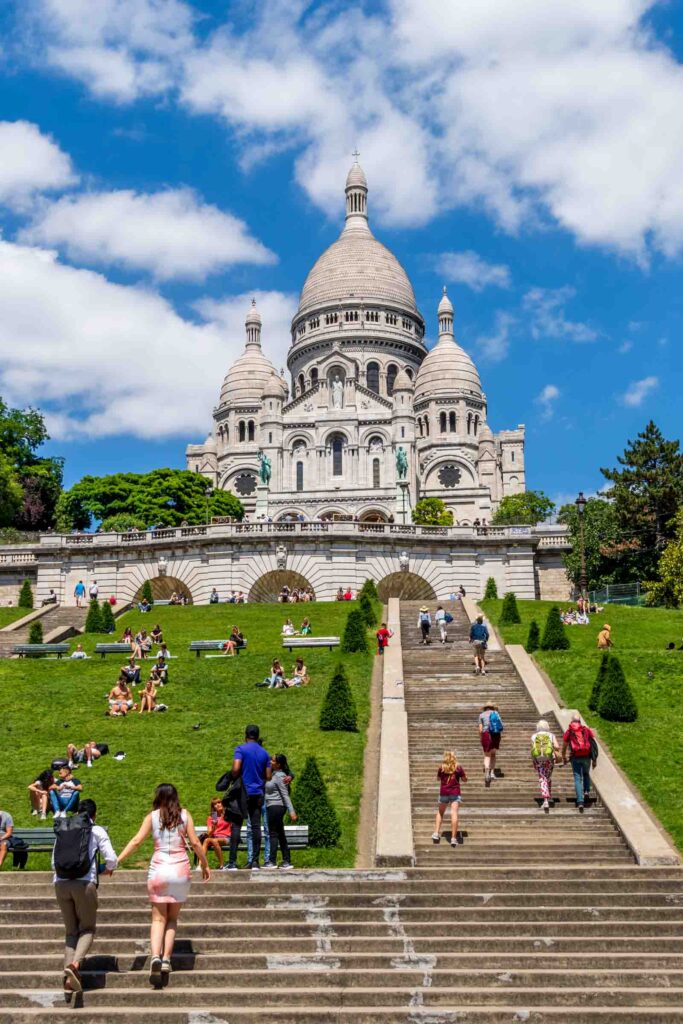
Built between 1875-1914, its Romano-Byzantine architecture houses beautiful mosaics and one of the world’s largest bells.
The climb up the dome provides even more spectacular views. Nevertheless, you’ll love the views from outside the church, as well, so there’s no need to put up with the fear of heights to get excellent photos of Paris.
Place du Tertre
Here’s the historic heart of Montmartre where artists still set up easels to paint portraits and landscapes. This charming square captures the bohemian spirit that made Montmartre famous, surrounded by cafés and galleries in 18th-century buildings.
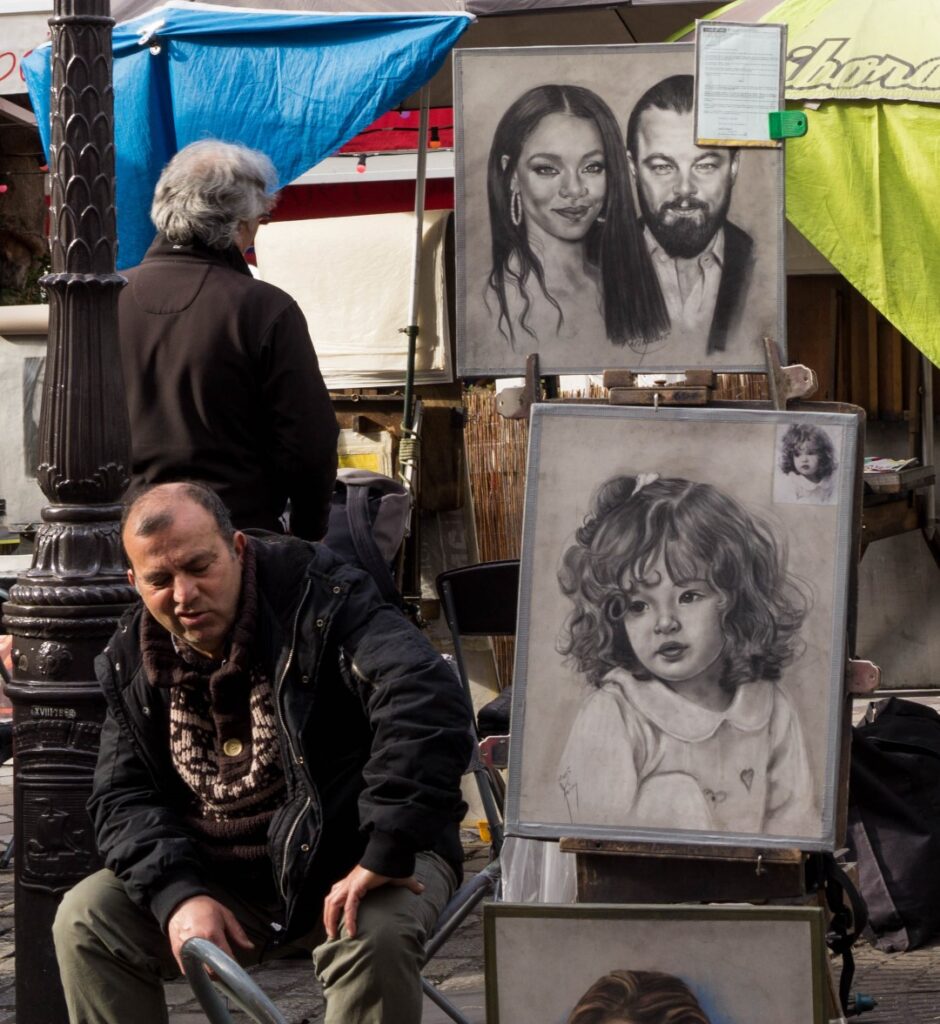
Artists in Place du Tertre would draw your portrait for money
It’s a touristy place, crowded and commercial, but still worth a visit.
Relax, have a coffee or a glass of wine at one of the bistros surrounding the square, and enjoy watching people passing by. If you’re hungry, get a platter of charcuterie (cold meats) and cheese. They are delicious and they won’t break your bank.
Moulin Rouge
Moulin Rouge is the world’s most famous cabaret, recognizable by its red windmill. While the original Belle Époque interior was destroyed by fire in 1915, the rebuilt venue continues the tradition of spectacular revues with elaborate costumes and choreography.
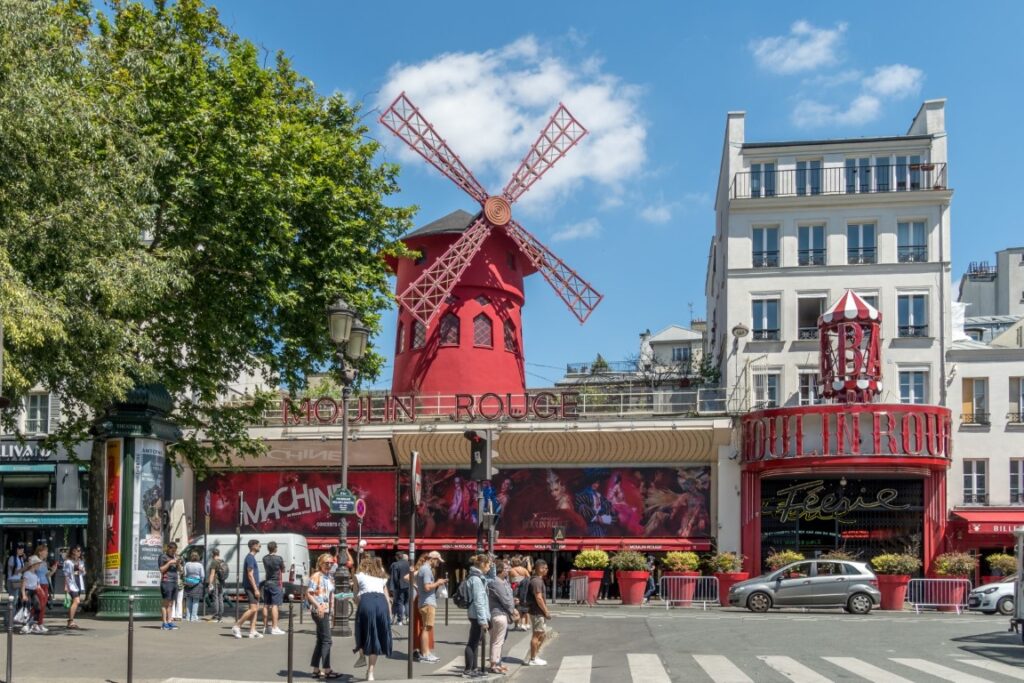
The windmill lost its wings to a storm in 2024 but it gained them back in 2025.
Basilique du Sacré-Cœur Funicular
The historic funicular railway, operating since 1900, carries visitors up the steep slope to Sacré-Coeur. It’s both practical transportation and a charming piece of Montmartre’s heritage.
The price of riding the funicular is the same as the price of a metro ticket. As of 2025, this is 2.50 Euro.
Day, week and month Navigo passes, as well as Paris Visite passes include the funicular.
Check out this article about using the public transport in Paris to see how and what kind of passes to buy.
Lesser-Known Gems
Cimetière de Montmartre
This peaceful cemetery houses the graves of famous artists, writers, and composers including Degas, Stendhal, and Jacques Offenbach. Dalida, the famous French singer is also buried there.
The elaborate tombs and tree-lined paths make it a contemplative escape from tourist crowds.
Le Mur des Je T’aimes (I Love You Wall)
This is a wall that showcases the words “I Love You” written in many languages. It can be the perfect place to propose in Paris.
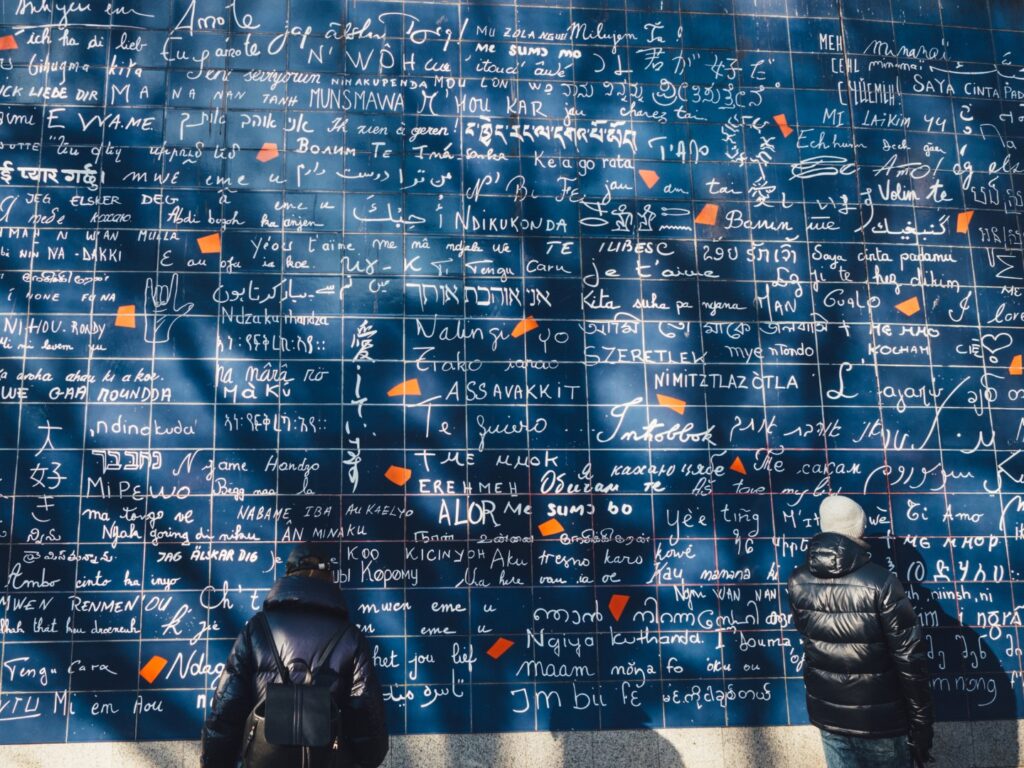
Mur des je t’aime – Montmartre (I Love You wall)
Read more about finding the I love You Wall.
Rue Foyatier Steps
The 222 steps leading up to Sacré-Cœur offer a more interesting route than the funicular, passing through terraced gardens and providing glimpses of hidden Montmartre courtyards.
In fact, Rue Foyatier is the street that runs parallel to the funicular rails to the top of the Montmartre hill. I’d choose this over the funicular any given time. However, if you can’t climb these many stairs, you’d better avoid it.
Le Passe-Muraille
A whimsical sculpture on Place Marcel Aymé depicting a man walking through a wall, inspired by Marcel Aymé’s short story “The Man Who Walked Through Walls.”
Vignes de Montmartre
Paris’s last remaining vineyard produces about 500 bottles annually during the Fête des Vendanges harvest festival in October.
The small plot on Rue des Saules offers a surprising rural touch in urban Paris.
Studio 28
The world’s first art cinema, opened in 1928, showcases independent and art house films in an intimate setting. The small theater’s crystal chandeliers and velvet seats preserve its historic charm.
This is where some scenes of the Amelie Poulain film with Audrey Tatou where shot.
Click here to see the history of Studio 28.
Getting There from the Airport
From Charles de Gaulle (CDG)
RER B + Metro (Most economical)
– Take RER B to Châtelet-Les Halles (35-40 minutes)
– Transfer to Metro Line 4 toward Porte de Clignancourt
– Get off at Marcadet-Poissonniers, then transfer to Line 12
– Take Line 12 to Pigalle or Abbesses
Taxi/Uber
– Direct route: 45-90 minutes depending on traffic
– Cost: €50-80 for taxi, €35-60 for Uber
From Orly (ORY)
Orlyval + RER B + Metro
– Take Orlyval to Antony, then RER B to Châtelet-Les Halles
– Follow same Metro connections as above
Taxi/Uber
– 30-60 minutes depending on traffic
– Cost: €35-55 for taxi, €25-45 for Uber
Neighborhood Overview
Montmartre unfolds on the highest hill in Paris at 130 meters, crowned by the iconic Sacré-Cœur Basilica. This historic district has maintained its village-like charm despite being in the heart of one of the world’s great cities.
Once home to artists like Picasso, Renoir, and Toulouse-Lautrec, Montmartre seamlessly blends artistic heritage with modern Parisian life.
The neighborhood divides into several distinct areas: the touristy summit around Sacré-Cœur and Place du Tertre, the edgier Pigalle district known for its nightlife, the residential slopes with winding cobblestone streets, and the Boulevard de Clichy at its base.
Best Hotels
Luxury
Hotel Particulier Montmartre: A hidden mansion-hotel with just five suites, each uniquely decorated by different artists. The property includes a secret garden and feels like a private residence rather than a hotel.
Terrass Hotel: Offering stunning views of Paris from its rooftop restaurant, this Art Deco hotel combines elegance with modern amenities. Many rooms have private terraces overlooking the city.
Mid-Range
Hotel des Arts Montmartre: A boutique hotel with artist-designed rooms, each paying homage to famous painters who lived in Montmartre. The location near Sacré-Cœur is perfect for exploring on foot.
Elysee Montmartre Hotel: A stylish hotel on Boulevard Marguerite de Rochechouart, right by the metro and only a short walk away from Sacre Coeur. Its beautiful decor has attracted many raving reviews from guests coming from all over the world.
Budget-Friendly
Hotel Regina Montmartre: A family-run hotel offering clean, comfortable rooms at reasonable prices. The Pigalle location provides easy Metro access while maintaining Montmartre’s neighborhood feel.
Apolonia Paris – Sure Hotel Collection by Best Western: Located in the residential area of Montmartre in Paris, a 10-minute walk from the Sacré-Coeur Basilica and Place du Tertre, this hotel provides great value for money.
Best Restaurants
Fine Dining
La Consigne: Beyond the hidden bar, this establishment serves refined French cuisine in an intimate setting. The seasonal menu showcases local ingredients prepared with modern techniques while respecting classic French traditions.
Le Moulin de la Galette: Housed in a historic windmill, this restaurant offers sophisticated French cuisine with a focus on seasonal ingredients. The terrace provides lovely views over Montmartre’s rooftops.
Bistros & Brasseries
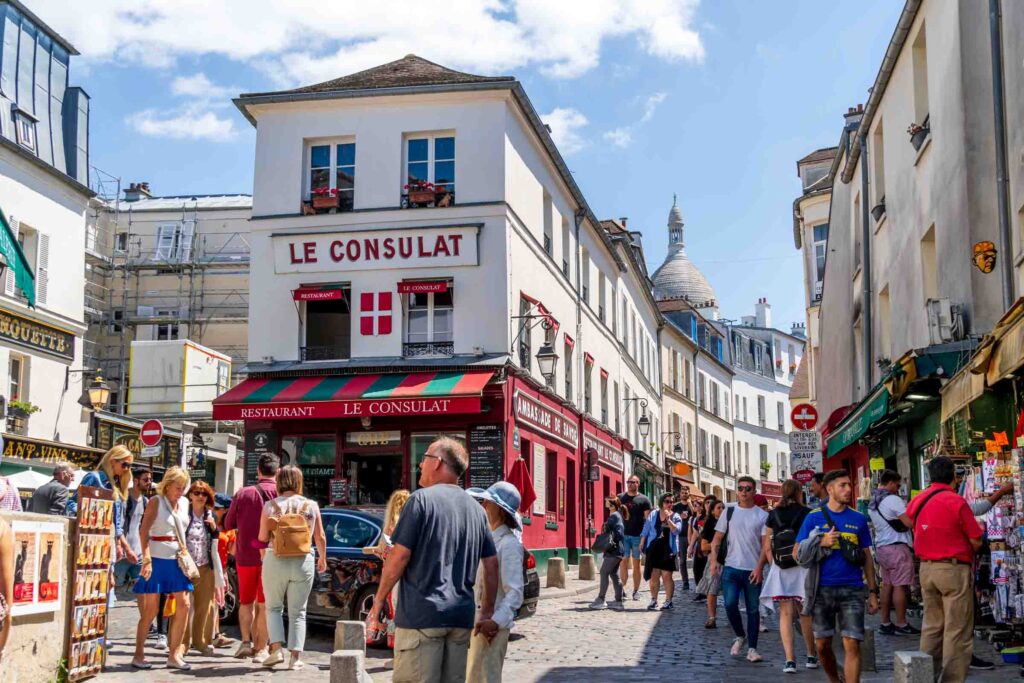
Le Consulat: A classic French bistro on Rue Norvins serving traditional dishes like coq au vin and escargot. The red-checked tablecloths and vintage posters create an authentic Parisian atmosphere.
Al Caratello: The bistro’s location perpendicular to rue des Abbesses places it in the vibrant heart of Montmartre, making it a perfect stop for those exploring the area around Sacré-Cœur. With its combination of authentic Italian flavors, generous portions, friendly service, and reasonable prices, Al Caratello has become a cherished dining destination that locals recommend to friends and visitors continue to discover.
Chez la Mère Catherine: The food at Chez la Mère Catherine is traditional French cooking. They serve dishes like frogs legs, pork confit, and crêpes suzette – the same kind of food they’ve been making since 1793. They also have lots of different wines to choose from.
The restaurant often has musicians playing music, which makes the atmosphere fun and lively. Because it’s so old and right in the middle of one of Paris’s most famous neighborhoods, eating there gives you a real taste of what Paris has been like for hundreds of years.
Cafés & Sweet Treats
Des Gâteaux et du Pain: A charming pâtisserie known for its artisanal pastries and bread. The lemon tart and croissants are particularly exceptional, making it perfect for breakfast or an afternoon treat.
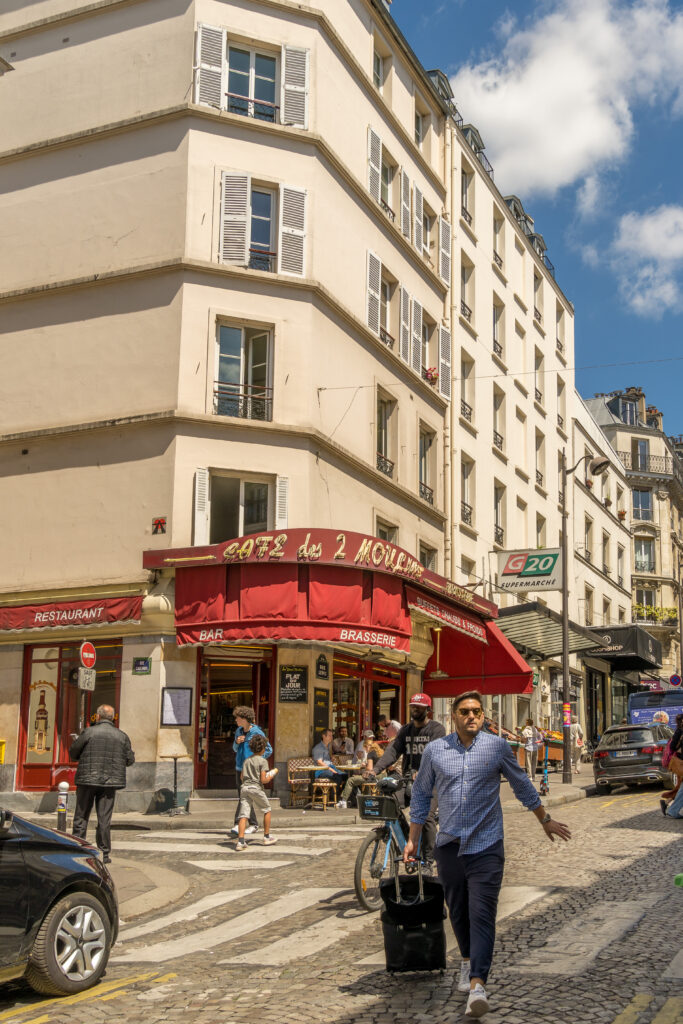
Le Café des Deux Moulins: Made famous by the film “Amélie,” this traditional café serves simple fare in an authentic Parisian setting. While touristy, it maintains its neighborhood character and offers good coffee and classic French onion soup.
Getting Around Montmartre
The steep streets and stairs make comfortable walking shoes essential. The area is well-served by Metro stations:
– Pigalle (Lines 2, 12): Best for Moulin Rouge and the base of Montmartre
– Abbesses (Line 12): Closest to the summit, features one of Paris’s few remaining Art Nouveau Metro entrances
– Anvers (Line 2): Good starting point for walking up to Sacré-Cœur
– Lamarck-Caulaincourt (Line 12): Accesses the quieter residential areas
The Montmartrobus is a small bus that navigates the narrow streets, connecting major sites within the district. It accepts regular Metro tickets and provides a rest for tired legs.
Best Times to Visit
Early morning offers the most peaceful experience at Sacré-Cœur before tour groups arrive.
Late afternoon provides the best light for photography, while evening brings the neighborhood’s nightlife to life. Sunset from the steps of Sacré-Cœur is particularly magical, with the city lights beginning to twinkle below.
The annual Fête des Vendanges in October celebrates the wine harvest with street festivals, while the Christmas season brings charming holiday markets to Place du Tertre.